Tic Tac Toe with Numbers, Letters or Sight Words


I just love Tic Tac Toe!  There can be so much to a game - the planning, the strategy and even reinforcement of academic skills.

I like to use half of a foam carton from a pack of 18 eggs.    

We select appealing objects to play with.  For some kids, that might mean Legos or Unifix cubes.  Pom Poms are always a great choice too! 


Kids play until they understand the game well.  Then it's time to add another element!


To work with letters, partners each choose a color.  Select the letters you want each child to focus on. Depending on the letters you select, this works well for kids who are learning their first few letters and also for kids who need reinforcement with a few letters they find tricky.       


This works well with numbers too! 


My favorite way to use this game is to reinforce knowledge of sight words.  Just tape the words your kids are working with onto colored tiles or unifix cubes and they're ready to go!   

To add some writing, have kids record the words they use for each game.       


I love simple, classic games that can be used in many different ways.  That makes Tic Tac Toe an all-time favorite for me!

Thanks for taking a look.  I hope you find these ideas helpful.  If you have favorite games that work throughout the year, I'd love to hear about them.  Anne  
Continue Reading

Don't Spill the Words


Here's a simple variation on the classic "Don't Spill the Beans" game that kids ask to play again and again. Just tape sight words onto tiles or unifix cubes and follow the directions for the original "Don't Spill the Beans" game. 


Also works well with magnetic letters!


Continue Reading

Long Vowel Scavenger Hunt - Oh So Simple!

Scavenger Hunts within Favorite Texts

I really want my kids to "see" how word study connects to reading their favorite books.   Here's a simple activity that's been helping kids understand these connections.

After we take a close look at a word feature, we go on a "scavenger hunt" to find words with that feature.  For instance, after we studied the long vowel/ silent e pattern, kids picked their favorite guided reading books and highlighted words with this pattern. 


Kids also read the pages they had selected, stressing the long vowel/ silent e patterns.  

Next week, we're going to try a scavenger hunt looking for  -ing endings. 

If you decide to try this out, want to let me know how it goes? 
Thanks!  Anne Gardner


Continue Reading


Building Fact Families

Awhile back, I saw a great idea from Margaret at KinderJourney. She was using clothes pins and craft sticks to build sight words. I loved the idea because kids enjoy working with the materials and get to develop important fine motor skills while also working with academic tasks.   

My kids couldn't get enough, so we started using these materials to build addition facts and then fact families.  


To build addition facts, just write the addition sign and equals sign on the craft sticks. Provide kids with sets of clothespins with numbers you are working with.  My kids love to fill a table with facts they have built!


Kids love building fact families too! I put the craft sticks and number pins that kids will need to build one fact family in a large ziploc bag. Kids then act as detectives to figure out what fact family they can build using these components. 

To develop an understanding of missing addend problems, kids pick up a "fact" and remove one of the pins.  Their partner has to figure out what number pin they removed.    

Works for multiplication/division fact families as well. 
  

If you decide to try this out, I'd love to hear how it works for you. Thanks for stopping by! Anne Gardner


Continue Reading

Heads and Tails Games: 
Using Coins to Help Kids Develop Math Concepts


At home, most kids have coins available. Kids are highly motivated to learn about money!  So - I love to use coins in math games. 

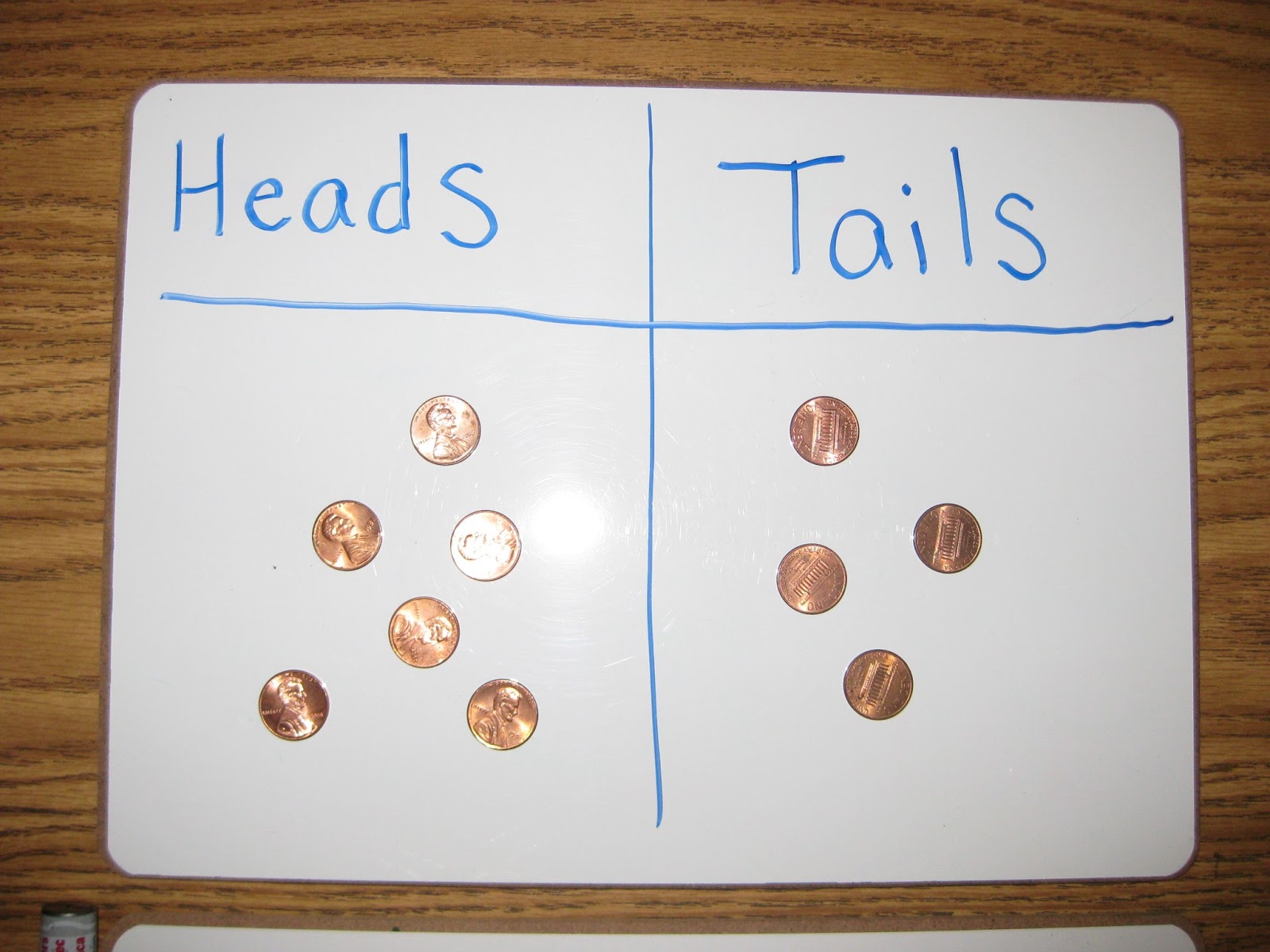
Heads and Tails is probably my all-time favorite math game.   Here are a couple variations that kids love to play at school and then go home and teach their families.  It is so flexible - kids can learn to play as they are learning to count and keep on playing variations of the game as they learn increasingly complex math skills. 

Basic Game - Getting Started with Counting Pennies:  Kids work with partners.  To start, one partner calls heads or tails.  The other partner drops the coins (either from his/her hand or out of a cup).  The child who has heads works with all the coins that land on heads.   The child who has tails works with all the coins that land on tails.   Each student counts his/her coins and the student with the coins having the highest value wins the round. 

As our Pre-K parents come in for orientation, we suggest this as a great game to play while waiting at the doctor's office, etc. 


Addition within Ten: Kids repeatedly play with a given number of coins.  They write the addition fact for each round.  


Adding More Coins: We start with all pennies, then add additional coins as students are ready for the challenge.  (Playing with all dimes is a great way for kids to practice counting by tens!)  


Comparing Numbers: As kids learn about <, > and = , we add a whiteboard and kids write their problem. 


Working with Two Digit Addition: When we work with 2 digit addition, kids work with coins worth one dollar.  They play Heads and Tails, then add their collections to make sure they each counted accurately.  (If their total is not equal to $1.00, they re-check their work.)

I hope you find these games useful.  Thanks for stopping by!   Anne

Continue Reading

You Can Bulldoze a b - Clearing up b/d confusion

Here's a little trick that helps my kids distinguish b from  d.  Once kids are confident working across a line of text from left to right, they are ready to "bulldoze" from left to right.   (If they need help remembering to start at the left a green sticker, for go, at the left  and a red sticker, for stop, at the right often help.) 

As they approach a b, they will find that you can bulldoze a b.   

Many kids who have started to get frustrated by issues distinguishing b and d really enjoy this activity.    


If kids try to bulldoze a d, it just tips over . . . .
   

Once this activity is introduced in a small group, kids enjoy independently "bulldozing each b" during literacy center time.  
Each time they bulldoze the letter b into a new box they say, "You can bulldoze a b!"   It really sticks with them!   


MatchBox and HotWheels often have small, inexpensive bulldozers available.  This one belonged to my son and I "inherited" it when he grew a bit old for it.  

Many of my kids love this activity.   I hope you find it useful!    

 :)   Anne

P.S. -  Do you have favorite ways to help kids distinguish b and d?  I'd love to hear about them!
Continue Reading

Addition Concentration Game


My kids love playing math games with cards! I like these games because most kids have the materials they need at home to keep on playing and practicing. Addition Concentration is one of my favorites. 

Kids work with a partner. They look through a deck of cards and find pairs of cards that add up to their target number. In the picture above, the target number is ten. It's easy to differentiate by giving students different target numbers. 

For a traditional game of Addition Concentration, players place cards on the table face down.  Partners take turns flipping two cards over.   If the numbers on the cards add up to 10, the player places the cards into the addition sentence and writes the addition fact.   Their partner then reverses the order of the cards and writes the related addition fact.    (I like to use whiteboards, but using Magna Doodles or paper and pencil also works well.)  

To switch it up a bit, try "Clean Sweep" memory.  The sweeper says, "I can sweep the board with 3 pairs."   Their partner then puts 3 pairs of cards, face up, on the table and gives the sweeper a few seconds to study the pairs.  The partner then flips the cards face down and the sweeper attempts  to find all the pairs that add up to the target number.  Partners switch roles and play continues. 

I like this variation because players are not guessing where numbers may be; they study the cards and build memory skills as they try to recall the location of pairs of cards.   If a child is able to sweep the board with 3 pairs, he/she can try to sweep the board with 4 pairs during his/her next turn.   Kids take great pride in sweeping the board with an increasing number of cards.

Because cards are readily available with so many different pictures, this can easily work into a variety of themes just by changing the deck of cards.


I also love to play with ten frame cards!

I hope you find this game useful.  Do you have favorite addition card games?   
I'd love to hear about them!          Anne  


Continue Reading